Defeated in battles at Chausa and Kannauj in 1539 to 1541 by the forces of Sher Shah Suri, Mughal emperor Humayun fled westward to Sindh.[18] There he met and married the then 14-year-old Hamida Banu Begum, daughter of Shaikh Ali Akbar Jami, a Persian teacher of Humayun's younger brother Hindal Mirza. Jalal ud-din Muhammad Akbar was born the next year on 25 October 1542[a] (the fifth day of Rajab, 949 AH)[12] at the Rajput Fortress of Amarkot in Rajputana (in modern-day Sindh), where his parents had been given refuge by the local Hindu ruler Rana Prasad.[20]
During the extended period of Humayun's exile, Akbar was brought up in Kabul by the extended family of his paternal uncles, Kamran Mirza and Askari Mirza, and his aunts, in particular Kamran Mirza's wife. He spent his youth learning to hunt, run, and fight, making him a daring, powerful, and brave warrior, but he never learned to read or write. This, however, did not hinder his search for knowledge as it is always said when he retired in the evening he would have someone read.[21][22] On 20 November 1551, Humayun's youngest brother, Hindal Mirza, died fighting in a battle against Kamran Mirza's forces. Upon hearing the news of his brother's death, Humayun was overwhelmed with grief.[23]
About the time of nine-year-old Akbar's first appointment, as governor of Ghazni, he married Hindal's daughter, Ruqaiya Sultan Begum.[24] Humayun conferred on the imperial couple all the wealth, army, and adherents of Hindal and Ghazni. One of Hindal's jagir was given to his nephew, Akbar, who was appointed as its viceroy and was also given the command of his uncle's army.[25] Akbar's marriage with Ruqaiya was solemnized in Jalandhar, Punjab, when both of them were 14-years-old.[26] She was his first wife and chief consort.[27][5]
Following the chaos over the succession of Sher Shah Suri's son Islam Shah, Humayun reconquered Delhi in 1555,[28] leading an army partly provided by his Persian ally Tahmasp I. A few months later, Humayun died. Akbar's guardian, Bairam Khan concealed the death in order to prepare for Akbar's succession. Akbar succeeded Humayun on 14 February 1556,[29] while in the midst of a war against Sikandar Shah to reclaim the Mughal throne. In Kalanaur, Punjab, the 14-year-old Akbar was enthroned by Bairam Khan on a newly constructed platform, which still stands.[30][31] He was proclaimed Shahanshah (Persian for "King of Kings").[29] Bairam Khan ruled on his behalf until he came of age.[32]
Military campaigns
Military innovations

Mughal Empire under Akbar's period (yellow)
Akbar had a record of unbeaten military campaigns that consolidated Mughal rule in the Indian subcontinent.[29][33] The basis of this military prowess and authority was Akbar's skilful structural and organisational calibration of the Mughal army.[34] The Mansabdari system in particular has been acclaimed for its role in upholding Mughal power in the time of Akbar. The system persisted with few changes down to the end of the Mughal Empire, but was progressively weakened under his successors.[34]
Organisational reforms were accompanied by innovations in cannons, fortifications, and the use of elephants.[33] Akbar also took an interest in matchlocks and effectively employed them during various conflicts. He sought the help of Ottomans, and also increasingly of Europeans, especially Portuguese and Italians, in procuring firearms and artillery.[35] Mughal firearms in the time of Akbar came to be far superior to anything that could be deployed by regional rulers, tributaries, or by zamindars.[36] Such was the impact of these weapons that Akbar's Vizier, Abul Fazl, once declared that "with the exception of Turkey, there is perhaps no country in which its guns has more means of securing the Government than [India]."[37] The term "gunpowder empire" has thus often been used by scholars and historians in analysing the success of the Mughals in India. Mughal power has been seen as owing to their mastery of the techniques of warfare, especially the use of firearms encouraged by Akbar.[38]
Struggle for North India
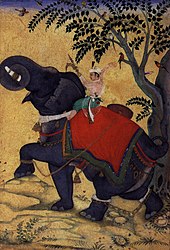
Mughal Emperor Akbar training an elephant
Akbar's father Humayun had regained control of the Punjab, Delhi, and Agra with Safavid support, but even in these areas Mughal rule was precarious, and when the Surs reconquered Agra and Delhi following the death of Humayun, the fate of the boy emperor seemed uncertain. Akbar's minority and the lack of any possibility of military assistance from the Mughal stronghold of Kabul, which was in the throes of an invasion by the ruler of Badakhshan Prince Mirza Suleiman, aggravated the situation.[39] When his regent, Bairam Khan, called a council of war to marshall the Mughal forces, none of Akbar's chieftains approved. Bairam Khan was ultimately able to prevail over the nobles, however, and it was decided that the Mughals would march against the strongest of the Sur rulers, Sikandar Shah Suri, in the Punjab. Delhi was left under the regency of Tardi Baig Khan.[39] Sikandar Shah Suri, however, presented no major concern for Akbar,[40] and avoided giving battle as the Mughal army approached.[citation needed] The gravest threat came from Hemu, a minister and general of one of the Sur rulers, who had proclaimed himself Hindu emperor and expelled the Mughals from the Indo-Gangetic plains.[39]
Urged by Bairam Khan, who re-marshalled the Mughal army before Hemu could consolidate his position, Akbar marched on Delhi to reclaim it.[41] His army, led by Bairam Khan, defeated Hemu and the Sur army on 5 November 1556 at the Second Battle of Panipat, 50 miles (80 km) north of Delhi.[42] Soon after the battle, Mughal forces occupied Delhi and then Agra. Akbar made a triumphant entry into Delhi, where he stayed for a month. Then he and Bairam Khan returned to Punjab to deal with Sikandar Shah, who had become active again.[43] In the next six months, the Mughals won another major battle against Sikander Shah Suri, who fled east to Bengal. Akbar and his forces occupied Lahore and then seized Multan in the Punjab. In 1558, Akbar took possession of Ajmer, the aperture to Rajputana, after the defeat and flight of its Muslim ruler.[43] The Mughals had also besieged and defeated the Sur forces in control of Gwalior Fort, the greatest stronghold north of the Narmada river.[43]
Royal begums, along with the families of Mughal amirs, were finally brought over from Kabul to India at the time – according to Akbar's vizier, Abul Fazl, "so that men might become settled and be restrained in some measure from departing to a country to which they were accustomed".[39] Akbar had firmly declared his intentions that the Mughals were in India to stay. This was a far cry from the political settlements of his grandfather, Babur, and father, Humayun, both of whom had done little to indicate that they were anything but transient rulers.[39][43] However, Akbar methodically re-introduced a historical legacy of the Timurid Renaissance that his ancestors had left.[44]
Expansion into Central India

Akbar hawking with Mughal chieftains and nobleman accompanied by his guardian Bairam Khan
By 1559, the Mughals had launched a drive to the south into Rajputana and Malwa.[45] However, Akbar's disputes with his regent, Bairam Khan, temporarily put an end to the expansion.[45] The young emperor, at the age of eighteen, wanted to take a more active part in managing affairs. Urged on by his foster mother, Maham Anga, and his relatives, Akbar decided to dispense with the services of Bairam Khan. After yet another dispute at court, Akbar finally dismissed Bairam Khan in the spring of 1560 and ordered him to leave on Hajj to Mecca.[46] Bairam Khan left for Mecca but on his way was goaded by his opponents to rebel.[42] He was defeated by the Mughal army in the Punjab and forced to submit. Akbar forgave him, however, and gave him the option of either continuing in his court or resuming his pilgrimage; Bairam chose the latter.[47] Bairam Khan was later assassinated on his way to Mecca, allegedly by an Afghan with a personal vendetta.[45]
In 1560, Akbar resumed military operations.[45] A Mughal army under the command of his foster brother, Adham Khan, and a Mughal commander, Pir Muhammad Khan, began the Mughal conquest of Malwa. The Afghan ruler, Baz Bahadur, was defeated at the Battle of Sarangpur and fled to Khandesh for refuge leaving behind his harem, treasure, and war elephants.[45] Despite initial success, the campaign proved a disaster from Akbar's point of view. His foster brother retained all the spoils and followed through with the Central Asian practice of slaughtering the surrendered garrison, their wives and children, and many Muslim theologians and Sayyids, who were the descendants of Muhammad.[45] Akbar personally rode to Malwa to confront Adham Khan and relieve him of command. Pir Muhammad Khan was then sent in pursuit of Baz Bahadur but was beaten back by the alliance of the rulers of Khandesh and Berar.[45] Baz Bahadur temporarily regained control of Malwa until, in the next year, Akbar sent another Mughal army to invade and annex the kingdom.[45] Malwa became a province of the nascent imperial administration of Akbar's regime. Baz Bahadur survived as a refugee at various courts until, eight years later in 1570, he took service under Akbar.[45]
Despite the ultimate success in Malwa, the conflict exposed cracks in Akbar's personal relationships with his relatives and Mughal nobles. When Adham Khan confronted Akbar following another dispute in 1562, he was struck down by the emperor and thrown from a terrace into the palace courtyard at Agra. Still alive, Adham Khan was dragged up and thrown to the courtyard once again by Akbar to ensure his death. Akbar now sought to eliminate the threat of over-mighty subjects.[45] He created specialised ministerial posts relating to imperial governance; no member of the Mughal nobility was to have unquestioned pre-eminence.[45] When a powerful clan of Uzbek chiefs broke out in rebellion in 1564, Akbar decisively defeated and routed them in Malwa and then Bihar.[48] He pardoned the rebellious leaders, hoping to conciliate them, but they rebelled again, so Akbar had to quell their uprising a second time. Following a third revolt with the proclamation of Mirza Muhammad Hakim, Akbar's brother and the Mughal ruler of Kabul, as emperor, his patience was finally exhausted. Several Uzbek chieftains were subsequently slain and the rebel leaders trampled to death under elephants.[48] Simultaneously the Mirzas, a group of Akbar's distant cousins who held important fiefs near Agra, had also risen up in rebellion. They too were slain and driven out of the empire.[48] In 1566, Akbar moved to meet the forces of his brother, Muhammad Hakim, who had marched into the Punjab with dreams of seizing the imperial throne. Following a brief confrontation, however, Muhammad Hakim accepted Akbar's supremacy and retreated back to Kabul.[48]
In 1564, Mughal forces began the conquest of Garha, a thinly populated, hilly area in central India that was of interest to the Mughals because of its herd of wild elephants.[49] The territory was ruled over by Raja Vir Narayan, a minor, and his mother, Durgavati, a Rajput warrior queen of the Gonds.[48] Akbar did not personally lead the campaign because he was preoccupied with the Uzbek rebellion, leaving the expedition in the hands of Asaf Khan, the Mughal governor of Kara.[48][50] Durgavati committed suicide after her defeat at the Battle of Damoh, while Raja Vir Narayan was slain at the Fall of Chauragarh, the mountain fortress of the Gonds.[50] The Mughals seized immense wealth, an uncalculated amount of gold and silver, jewels, and 1000 elephants. Kamala Devi, a younger sister of Durgavati, was sent to the Mughal harem.[50] The brother of Durgavati's deceased husband was installed as the Mughal administrator of the region.[50] Like in Malwa, however, Akbar entered into a dispute with his vassals over the conquest of Gondwana.[50] Asaf Khan was accused of keeping most of the treasures and sending back only 200 elephants to Akbar. When summoned to give accounts, he fled Gondwana. He went first to the Uzbeks, then returned to Gondwana where he was pursued by Mughal forces. Finally, he submitted and Akbar restored him to his previous position.[50]
Attempt to murder Akbar
Around 1564 is also when there was an assassination attempt on Akbar documented in a painting. The attempt was made when Akbar was returning from a visit to the dargah of Hazrat Nizamuddin near Delhi, by an assassin shooting an arrow. The arrow pierced his right shoulder. The assassin was apprehended and ordered beheaded by the Emperor. The culprit was a slave of Mirza Sharfuddin, a noble in Akbar's court whose rebellion had recently been curbed.[51]
Conquest of Rajputana
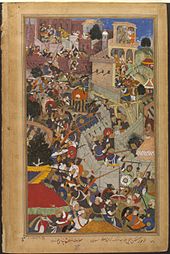
Mughal Emperor Akbar shoots the Rajput warrior Jaimal during the Siege of Chittorgarh in 1568

Bullocks dragging siege-guns uphill during Akbar's attack on Ranthambhor Fort in 1568
Having established Mughal rule over northern India, Akbar turned his attention to the conquest of Rajputana. No imperial power in India based on the Indo-Gangetic plains could be secure if a rival centre of power existed on its flank in Rajputana.[50] The Mughals had already established domination over parts of northern Rajputana in Mewat, Ajmer, and Nagor.[43][48] Now, Akbar was determined to drive into the heartlands of the Rajput kings that had rarely previously submitted to the Muslim rulers of the Delhi Sultanate. Beginning in 1561, the Mughals actively engaged the Rajputs in warfare and diplomacy.[49] Most Rajput states accepted Akbar's suzerainty; the rulers of Mewar and Marwar, Udai Singh, and Chandrasen Rathore, however, remained outside the imperial fold.[48] Rana Udai Singh was descended from the Sisodia ruler, Rana Sanga, who had fought Babur at the Battle of Khanwa in 1527.[48] As the head of the Sisodia clan, he possessed the highest ritual status of all the Rajput kings and chieftains in India.[citation needed] Unless Udai Singh was reduced to submission, the imperial authority of the Mughals would be lessened in Rajput eyes.[48] Furthermore, Akbar, at this early period, was still enthusiastically devoted to the cause of Islam and sought to impress the superiority of his faith over the most prestigious warriors in Brahminical Hinduism.[48]
In 1567, Akbar moved to reduce the Chittor Fort in Mewar. The fortress-capital of Mewar was of great strategic importance as it lay on the shortest route from Agra to Gujarat and was also considered a key to holding the interior parts of Rajputana. Udai Singh retired to the hills of Mewar, leaving two Rajput warriors, Jaimal and Patta, in charge of the defence of his capital.[52] Chittorgarh fell in February 1568 after a siege of four months. Akbar had the surviving defenders and 30,000 non-combatants massacred and their heads displayed upon towers erected throughout the region, in order to demonstrate his authority.[53][54] The booty that fell into the hands of the Mughals was distributed throughout the empire.[55] He remained in Chittorgarh for three days, then returned to Agra, where to commemorate the victory, he set up, at the gates of his fort, statues of Jaimal and Patta mounted on elephants.[56] Udai Singh's power and influence was broken. He never again ventured out of his mountain refuge in Mewar and Akbar was content to let him be.[57]
The fall of Chittorgarh was followed up by a Mughal attack on the Ranthambore Fort in 1568. Ranthambore was held by the Hada Rajputs and reputed to be the most powerful fortress in India.[57] However, it fell only after a couple of months.[57] Akbar was now the master of almost the whole of Rajputana. Most of the Rajput kings had submitted to the Mughals.[57] Only the clans of Mewar continued to resist.[57] Udai Singh's son and successor, Pratap Singh, was later defeated by the Mughals at the Battle of Haldighati in 1576.[57] Akbar would celebrate his conquest of Rajputana by laying the foundation of a new capital, 23 miles (37 km) W.S.W of Agra in 1569. It was called Fatehpur Sikri ("the city of victory").[58] Rana Pratap Singh, however, continuously attacked Mughals and was able to retain most of the kingdom of his ancestors in the life of Akbar.[59]
Annexation of Western and Eastern India

The court of young Akbar, age 13, showing his first imperial act: the arrest of an unruly courtier, who was once a favourite of Akbar's father. Illustration from a manuscript of the Akbarnama
Akbar's next military objectives were the conquest of Gujarat and Bengal, which connected India with the trading centres of Asia, Africa, and Europe through the Arabian Sea and the Bay of Bengal respectively.[57] Furthermore, Gujarat had been a haven for rebellious Mughal nobles, while in Bengal, the Afghans still held considerable influence under their ruler, Sulaiman Khan Karrani. Akbar first moved against Gujarat, which lay in the crook of the Mughal provinces of Rajputana and Malwa.[57] Gujarat, with its coastal regions, possessed areas of rich agricultural production in its central plain, an impressive output of textiles and other industrial goods, and the busiest seaports of India.[57][60] Akbar intended to link the maritime state with the massive resources of the Indo-Gangetic plains.[61] However, the ostensible casus belli was that the rebel Mirzas, who had previously been driven out of India, were now operating out of a base in southern Gujarat. Moreover, Akbar had received invitations from cliques in Gujarat to oust the reigning king, which served as justification for his military expedition.[57] In 1572, he moved to occupy Ahmedabad, the capital, and other northern cities, and was proclaimed the lawful sovereign of Gujarat. By 1573, he had driven out the Mirzas who, after offering token resistance, fled for refuge in the Deccan. Surat, the commercial capital of the region, and other coastal cities soon capitulated to the Mughals.[57] The king, Muzaffar Shah III, was caught hiding in a corn field; he was pensioned off by Akbar with a small allowance.[57]
Having established his authority over Gujarat, Akbar returned to Fatehpur Sikiri, where he built the Buland Darwaza to commemorate his victories, but a rebellion by Afghan nobles supported by the Rajput ruler of Idar, and the renewed intrigues of the Mirzas forced his return to Gujarat.[61] Akbar crossed the Rajputana and reached Ahmedabad in eleven days – a journey that normally took six weeks. The outnumbered Mughal army then won a decisive victory on September 2, 1573. Akbar slew the rebel leaders and erected a tower out of their severed heads.[57] The conquest and subjugation of Gujarat proved highly profitable for the Mughals; the territory yielded a revenue of more than five million rupees annually to Akbar's treasury, after expenses.[57]
Akbar had now defeated most of the Afghan remnants in India. The only centre of Afghan power was now in Bengal, where Sulaiman Khan Karrani, an Afghan chieftain whose family had served under Sher Shah Suri, was reigning in power. While Sulaiman Khan scrupulously avoided giving offence to Akbar, his son, Daud Khan, who had succeeded him in 1572, decided otherwise.[62] Whereas Sulaiman Khan had the khutba read in Akbar's name and acknowledged Mughal supremacy, Daud Khan assumed the insignia of royalty and ordered the khutba to be proclaimed in his own name in defiance of Akbar. Munim Khan, the Mughal governor of Bihar, was ordered to chastise Daud Khan, but later, Akbar himself set out to Bengal.[62] This was an opportunity to bring the trade in the east under Mughal control.[63] In 1574, the Mughals seized Patna from Daud Khan, who fled to Bengal.[62] Akbar returned to Fatehpur Sikri and left his generals to finish the campaign. The Mughal army was subsequently victorious at the Battle of Tukaroi in 1575, which led to the annexation of Bengal and parts of Bihar that had been under the dominion of Daud Khan. Only Orissa was left in the hands of the Karrani dynasty as a fief of the Mughal Empire. A year later, however, Daud Khan rebelled and attempted to regain Bengal. He was defeated by the Mughal general, Khan Jahan Quli, and had to flee into exile. Daud Khan was later captured and executed by Mughal forces. His severed head was sent to Akbar, while his limbs were gibbeted at Tandah, the Mughal capital in Bengal.[62]
