Conquest of Rajputana
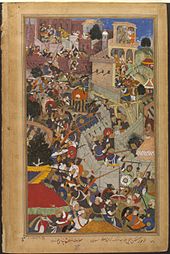
Mughal Emperor Akbar shoots the Rajput warrior Jaimal during the Siege of Chittorgarh in 1568

Bullocks dragging siege-guns uphill during Akbar's attack on Ranthambhor Fort in 1568
Having established Mughal rule over northern India, Akbar turned his attention to the conquest of Rajputana. No imperial power in India based on the Indo-Gangetic plains could be secure if a rival centre of power existed on its flank in Rajputana.[50] The Mughals had already established domination over parts of northern Rajputana in Mewat, Ajmer, and Nagor.[43][48] Now, Akbar was determined to drive into the heartlands of the Rajput kings that had rarely previously submitted to the Muslim rulers of the Delhi Sultanate. Beginning in 1561, the Mughals actively engaged the Rajputs in warfare and diplomacy.[49] Most Rajput states accepted Akbar's suzerainty; the rulers of Mewar and Marwar, Udai Singh, and Chandrasen Rathore, however, remained outside the imperial fold.[48] Rana Udai Singh was descended from the Sisodia ruler, Rana Sanga, who had fought Babur at the Battle of Khanwa in 1527.[48] As the head of the Sisodia clan, he possessed the highest ritual status of all the Rajput kings and chieftains in India.[citation needed] Unless Udai Singh was reduced to submission, the imperial authority of the Mughals would be lessened in Rajput eyes.[48] Furthermore, Akbar, at this early period, was still enthusiastically devoted to the cause of Islam and sought to impress the superiority of his faith over the most prestigious warriors in Brahminical Hinduism.[48]
In 1567, Akbar moved to reduce the Chittor Fort in Mewar. The fortress-capital of Mewar was of great strategic importance as it lay on the shortest route from Agra to Gujarat and was also considered a key to holding the interior parts of Rajputana. Udai Singh retired to the hills of Mewar, leaving two Rajput warriors, Jaimal and Patta, in charge of the defence of his capital.[52] Chittorgarh fell in February 1568 after a siege of four months. Akbar had the surviving defenders and 30,000 non-combatants massacred and their heads displayed upon towers erected throughout the region, in order to demonstrate his authority.[53][54] The booty that fell into the hands of the Mughals was distributed throughout the empire.[55] He remained in Chittorgarh for three days, then returned to Agra, where to commemorate the victory, he set up, at the gates of his fort, statues of Jaimal and Patta mounted on elephants.[56] Udai Singh's power and influence was broken. He never again ventured out of his mountain refuge in Mewar and Akbar was content to let him be.[57]
The fall of Chittorgarh was followed up by a Mughal attack on the Ranthambore Fort in 1568. Ranthambore was held by the Hada Rajputs and reputed to be the most powerful fortress in India.[57] However, it fell only after a couple of months.[57] Akbar was now the master of almost the whole of Rajputana. Most of the Rajput kings had submitted to the Mughals.[57] Only the clans of Mewar continued to resist.[57] Udai Singh's son and successor, Pratap Singh, was later defeated by the Mughals at the Battle of Haldighati in 1576.[57] Akbar would celebrate his conquest of Rajputana by laying the foundation of a new capital, 23 miles (37 km) W.S.W of Agra in 1569. It was called Fatehpur Sikri ("the city of victory").[58] Rana Pratap Singh, however, continuously attacked Mughals and was able to retain most of the kingdom of his ancestors in the life of Akbar.[59]
Annexation of Western and Eastern India

The court of young Akbar, age 13, showing his first imperial act: the arrest of an unruly courtier, who was once a favourite of Akbar's father. Illustration from a manuscript of the Akbarnama
Akbar's next military objectives were the conquest of Gujarat and Bengal, which connected India with the trading centres of Asia, Africa, and Europe through the Arabian Sea and the Bay of Bengal respectively.[57] Furthermore, Gujarat had been a haven for rebellious Mughal nobles, while in Bengal, the Afghans still held considerable influence under their ruler, Sulaiman Khan Karrani. Akbar first moved against Gujarat, which lay in the crook of the Mughal provinces of Rajputana and Malwa.[57] Gujarat, with its coastal regions, possessed areas of rich agricultural production in its central plain, an impressive output of textiles and other industrial goods, and the busiest seaports of India.[57][60] Akbar intended to link the maritime state with the massive resources of the Indo-Gangetic plains.[61] However, the ostensible casus belli was that the rebel Mirzas, who had previously been driven out of India, were now operating out of a base in southern Gujarat. Moreover, Akbar had received invitations from cliques in Gujarat to oust the reigning king, which served as justification for his military expedition.[57] In 1572, he moved to occupy Ahmedabad, the capital, and other northern cities, and was proclaimed the lawful sovereign of Gujarat. By 1573, he had driven out the Mirzas who, after offering token resistance, fled for refuge in the Deccan. Surat, the commercial capital of the region, and other coastal cities soon capitulated to the Mughals.[57] The king, Muzaffar Shah III, was caught hiding in a corn field; he was pensioned off by Akbar with a small allowance.[57]
Having established his authority over Gujarat, Akbar returned to Fatehpur Sikiri, where he built the Buland Darwaza to commemorate his victories, but a rebellion by Afghan nobles supported by the Rajput ruler of Idar, and the renewed intrigues of the Mirzas forced his return to Gujarat.[61] Akbar crossed the Rajputana and reached Ahmedabad in eleven days – a journey that normally took six weeks. The outnumbered Mughal army then won a decisive victory on September 2, 1573. Akbar slew the rebel leaders and erected a tower out of their severed heads.[57] The conquest and subjugation of Gujarat proved highly profitable for the Mughals; the territory yielded a revenue of more than five million rupees annually to Akbar's treasury, after expenses.[57]
Akbar had now defeated most of the Afghan remnants in India. The only centre of Afghan power was now in Bengal, where Sulaiman Khan Karrani, an Afghan chieftain whose family had served under Sher Shah Suri, was reigning in power. While Sulaiman Khan scrupulously avoided giving offence to Akbar, his son, Daud Khan, who had succeeded him in 1572, decided otherwise.[62] Whereas Sulaiman Khan had the khutba read in Akbar's name and acknowledged Mughal supremacy, Daud Khan assumed the insignia of royalty and ordered the khutba to be proclaimed in his own name in defiance of Akbar. Munim Khan, the Mughal governor of Bihar, was ordered to chastise Daud Khan, but later, Akbar himself set out to Bengal.[62] This was an opportunity to bring the trade in the east under Mughal control.[63] In 1574, the Mughals seized Patna from Daud Khan, who fled to Bengal.[62] Akbar returned to Fatehpur Sikri and left his generals to finish the campaign. The Mughal army was subsequently victorious at the Battle of Tukaroi in 1575, which led to the annexation of Bengal and parts of Bihar that had been under the dominion of Daud Khan. Only Orissa was left in the hands of the Karrani dynasty as a fief of the Mughal Empire. A year later, however, Daud Khan rebelled and attempted to regain Bengal. He was defeated by the Mughal general, Khan Jahan Quli, and had to flee into exile. Daud Khan was later captured and executed by Mughal forces. His severed head was sent to Akbar, while his limbs were gibbeted at Tandah, the Mughal capital in Bengal.[62]
Campaigns in Afghanistan and Central Asia
Following his conquests of Gujarat and Bengal, Akbar was preoccupied with domestic concerns. He did not leave Fatehpur Sikri on a military campaign until 1581, when Punjab was again invaded by his brother, Mirza Muhammad Hakim. Akbar expelled his brother to Kabul and this time pressed on, determined to end the threat from Muhammad Hakim once and for all. In contrast to the problem that his predecessors once had in getting Mughal nobles to stay on in India, the problem now was to get them to leave India. They were, according to Abul Fazl "afraid of the cold of Afghanistan." The Hindu officers, in turn, were additionally inhibited by the traditional taboo against crossing the Indus. Akbar, however, spurred them on. The soldiers were provided with pay eight months in advance. In August 1581, Akbar seized Kabul and took up residence at Babur's old citadel. He stayed there for three weeks, in the absence of his brother, who had fled into the mountains. Akbar left Kabul in the hands of his sister, Bakht-un-Nissa Begum, and returned to India. He pardoned his brother, who took up de facto charge of the Mughal administration in Kabul; Bakht-un-Nissa continued to be the official governor. A few years later, in 1585, Muhammad Hakim died and Kabul passed into the hands of Akbar once again. It was officially incorporated as a province of the Mughal Empire.[62]
