Defeated in battles at Chausa and Kannauj in 1539 to 1541 by the forces of Sher Shah Suri, Mughal emperor Humayun fled westward to Sindh.[19] There he met and married the then 14-year-old Hamida Banu Begum, daughter of Shaikh Ali Akbar Jami, a Persian teacher of Humayun's younger brother Hindal Mirza. Jalal ud-din Muhammad Akbar was born the next year on 25 October 1542[a] (the fifth day of Rajab, 949 AH)[13] at the Rajput Fortress of Amarkot in Rajputana (in modern-day Sindh), where his parents had been given refuge by the local Hindu ruler Rana Prasad.[21]
During the extended period of Humayun's exile, Akbar was brought up in Kabul by the extended family of his paternal uncles, Kamran Mirza and Askari Mirza, and his aunts, in particular Kamran Mirza's wife. He spent his youth learning to hunt, run, and fight, making him a daring, powerful and brave warrior, but he never learned to read or write. This, however, did not hinder his search for knowledge as it is always said when he retired in the evening he would have someone read.[22][23] On 20 November 1551, Humayun's youngest brother, Hindal Mirza, died fighting in a battle against Kamran Mirza's forces. Upon hearing the news of his brother's death, Humayun was overwhelmed with grief.[24]
About the time of nine-year-old Akbar's first appointment, as governor of Ghazni, he married Hindal's daughter, Ruqaiya Sultan Begum.[25] Humayun conferred on the imperial couple all the wealth, army, and adherents of Hindal and Ghazni. One of Hindal's jagir was given to his nephew, Akbar, who was appointed as its viceroy and was also given the command of his uncle's army.[26] Akbar's marriage with Ruqaiya was solemnized in Jalandhar, Punjab, when both of them were 14-years-old.[27] She was his first wife and chief consort.[28][5]
Following the chaos over the succession of Sher Shah Suri's son Islam Shah, Humayun reconquered Delhi in 1555,[29] leading an army partly provided by his Persian ally Tahmasp I. A few months later, Humayun died. Akbar's guardian, Bairam Khan concealed the death in order to prepare for Akbar's succession. Akbar succeeded Humayun on 14 February 1556,[30] while in the midst of a war against Sikandar Shah to reclaim the Mughal throne. In Kalanaur, Punjab, the 14-year-old Akbar was enthroned by Bairam Khan on a newly constructed platform, which still stands.[31][32] He was proclaimed Shahanshah (Persian for "King of Kings").[30] Bairam Khan ruled on his behalf until he came of age.[33]
Military campaigns
Military innovations

Mughal Empire under Akbar's period (yellow)
Akbar had a record of unbeaten military campaigns that consolidated Mughal rule in the Indian subcontinent.[30][34] The basis of this military prowess and authority was Akbar's skilful structural and organisational calibration of the Mughal army.[35] The Mansabdari system in particular has been acclaimed for its role in upholding Mughal power in the time of Akbar. The system persisted with few changes down to the end of the Mughal Empire, but was progressively weakened under his successors.[35]
Organisational reforms were accompanied by innovations in cannons, fortifications, and the use of elephants.[34] Akbar also took an interest in matchlocks and effectively employed them during various conflicts. He sought the help of Ottomans, and also increasingly of Europeans, especially Portuguese and Italians, in procuring firearms and artillery.[36] Mughal firearms in the time of Akbar came to be far superior to anything that could be deployed by regional rulers, tributaries, or by zamindars.[37] Such was the impact of these weapons that Akbar's Vizier, Abul Fazl, once declared that "with the exception of Turkey, there is perhaps no country in which its guns has more means of securing the Government than [India]."[38] The term "gunpowder empire" has thus often been used by scholars and historians in analysing the success of the Mughals in India. Mughal power has been seen as owing to their mastery of the techniques of warfare, especially the use of firearms encouraged by Akbar.[39]
Struggle for North India
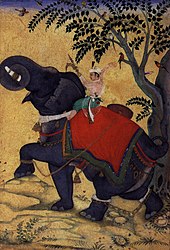
Mughal Emperor Akbar training an elephant
Akbar's father Humayun had regained control of the Punjab, Delhi, and Agra with Safavid support, but even in these areas Mughal rule was precarious, and when the Surs reconquered Agra and Delhi following the death of Humayun, the fate of the boy emperor seemed uncertain. Akbar's minority and the lack of any possibility of military assistance from the Mughal stronghold of Kabul, which was in the throes of an invasion by the ruler of Badakhshan Prince Mirza Suleiman, aggravated the situation.[40] When his regent, Bairam Khan, called a council of war to marshall the Mughal forces, none of Akbar's chieftains approved. Bairam Khan was ultimately able to prevail over the nobles, however, and it was decided that the Mughals would march against the strongest of the Sur rulers, Sikandar Shah Suri, in the Punjab. Delhi was left under the regency of Tardi Baig Khan.[40] Sikandar Shah Suri, however, presented no major concern for Akbar,[41] and avoided giving battle as the Mughal army approached.[citation needed] The gravest threat came from Hemu, a minister and general of one of the Sur rulers, who had proclaimed himself Hindu emperor and expelled the Mughals from the Indo-Gangetic plains.[40]
Urged by Bairam Khan, who re-marshalled the Mughal army before Hemu could consolidate his position, Akbar marched on Delhi to reclaim it.[42] His army, led by Bairam Khan, defeated Hemu and the Sur army on 5 November 1556 at the Second Battle of Panipat, 50 miles (80 km) north of Delhi.[43] Soon after the battle, Mughal forces occupied Delhi and then Agra. Akbar made a triumphant entry into Delhi, where he stayed for a month. Then he and Bairam Khan returned to Punjab to deal with Sikandar Shah, who had become active again.[44] In the next six months, the Mughals won another major battle against Sikander Shah Suri, who fled east to Bengal. Akbar and his forces occupied Lahore and then seized Multan in the Punjab. In 1558, Akbar took possession of Ajmer, the aperture to Rajputana, after the defeat and flight of its Muslim ruler.[44] The Mughals had also besieged and defeated the Sur forces in control of Gwalior Fort, the greatest stronghold north of the Narmada river.[44]
Royal begums, along with the families of Mughal amirs, were finally brought over from Kabul to India at the time – according to Akbar's vizier, Abul Fazl, "so that men might become settled and be restrained in some measure from departing to a country to which they were accustomed".[40] Akbar had firmly declared his intentions that the Mughals were in India to stay. This was a far cry from the political settlements of his grandfather, Babur, and father, Humayun, both of whom had done little to indicate that they were anything but transient rulers.[40][44] However, Akbar methodically re-introduced a historical legacy of the Timurid Renaissance that his ancestors had left.[45]
Expansion into Central India

Akbar hawking with Mughal chieftains and nobleman accompanied by his guardian Bairam Khan
By 1559, the Mughals had launched a drive to the south into Rajputana and Malwa.[46] However, Akbar's disputes with his regent, Bairam Khan, temporarily put an end to the expansion.[46] The young emperor, at the age of eighteen, wanted to take a more active part in managing affairs. Urged on by his foster mother, Maham Anga, and his relatives, Akbar decided to dispense with the services of Bairam Khan. After yet another dispute at court, Akbar finally dismissed Bairam Khan in the spring of 1560 and ordered him to leave on Hajj to Mecca.[47] Bairam Khan left for Mecca but on his way was goaded by his opponents to rebel.[43] He was defeated by the Mughal army in the Punjab and forced to submit. Akbar forgave him, however, and gave him the option of either continuing in his court or resuming his pilgrimage; Bairam chose the latter.[48] Bairam Khan was later assassinated on his way to Mecca, allegedly by an Afghan with a personal vendetta.[46]
In 1560, Akbar resumed military operations.[46] A Mughal army under the command of his foster brother, Adham Khan, and a Mughal commander, Pir Muhammad Khan, began the Mughal conquest of Malwa. The Afghan ruler, Baz Bahadur, was defeated at the Battle of Sarangpur and fled to Khandesh for refuge leaving behind his harem, treasure, and war elephants.[46] Despite initial success, the campaign proved a disaster from Akbar's point of view. His foster brother retained all the spoils and followed through with the Central Asian practice of slaughtering the surrendered garrison, their wives and children, and many Muslim theologians and Sayyids, who were the descendants of Muhammad.[46] Akbar personally rode to Malwa to confront Adham Khan and relieve him of command. Pir Muhammad Khan was then sent in pursuit of Baz Bahadur but was beaten back by the alliance of the rulers of Khandesh and Berar.[46] Baz Bahadur temporarily regained control of Malwa until, in the next year, Akbar sent another Mughal army to invade and annex the kingdom.[46] Malwa became a province of the nascent imperial admin
